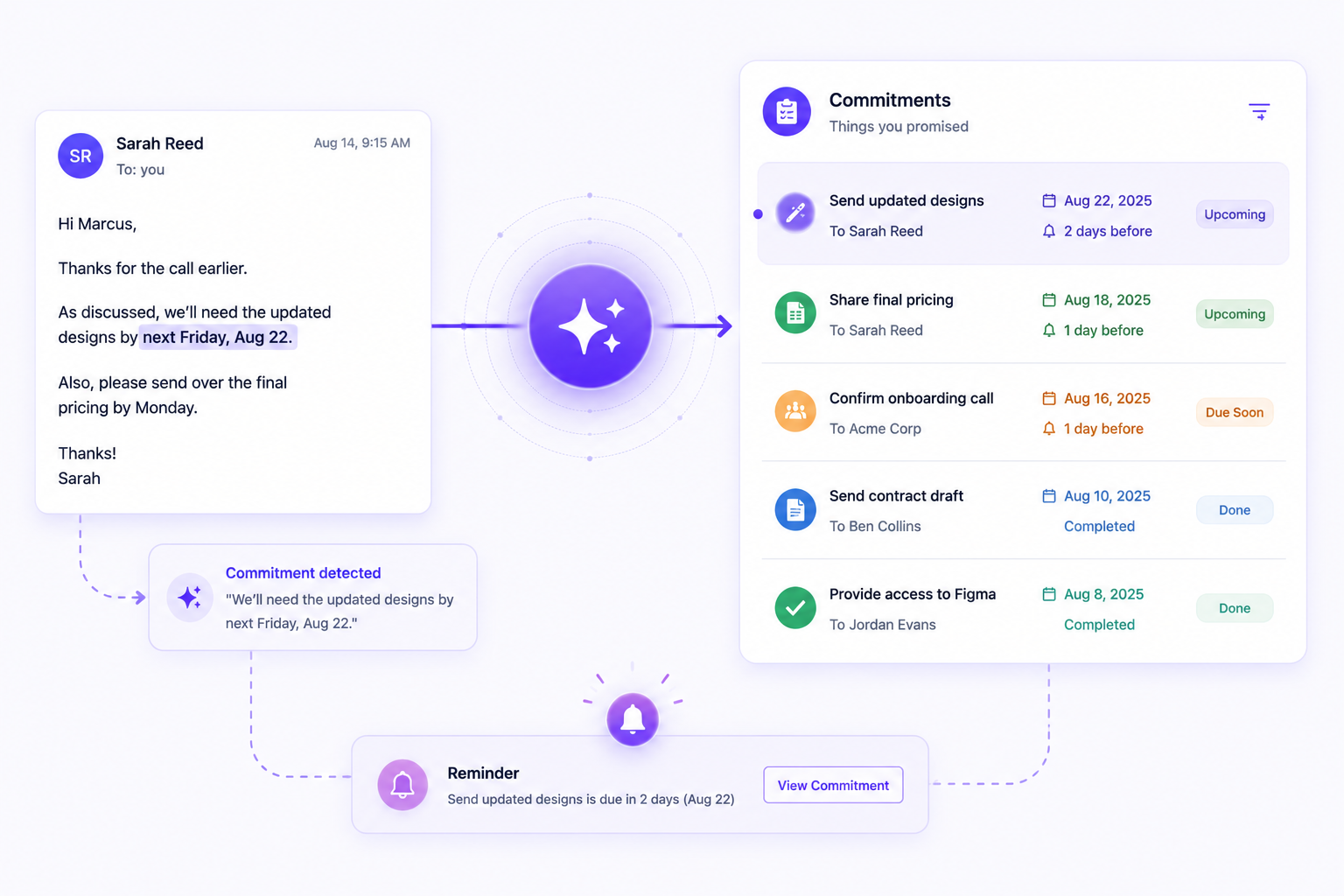
The thing you promised is now on a list.
CevroFlow pulls the commitment out of the email, gives it a due date, and reminds you before it is late.
In the thread
Great, that all works. I will get the revised numbers over to you by Friday so you can review before the board meeting.
You, in Re: Q3 forecast
Send the revised numbers
88%Friday, 22 August
from “by Friday”Owner: You
Above 70%, so it was created for you.
See it working
The promise pulled out of the email, dated, and sitting on a list you can actually work from.
What it actually does
- 1
It reads for a commitment
Not a keyword. "I will send the proposal tomorrow" is a task. A message that merely mentions a proposal is not.
Detected during the same single read as the category.
- 2
The date is resolved in code
The model extracts the hint, such as end of week or next Tuesday. Actual date arithmetic is done by ordinary code, because that is where models are least reliable.
resolveDueHint(), never the model.
- 3
It creates or it asks
At seventy percent confidence and above the task is created for you. Below that it is offered as a suggestion you accept or dismiss.
Auto-create at 70%. Below, it asks.
It knows when not to act
Seventy percent is the bar for creating a task without asking. Below it, CevroFlow offers rather than decides — because a list full of things you never agreed to is worse than no list. The threshold is a constant in the product, not a setting you have to tune.
- The model reads the promise; ordinary code works out the date, because date arithmetic is what models are least reliable at.
- A vague hint stays vague. “Soon” produces a task with no date rather than a date it invented.
The task is created
Clear enough that acting on it saves you a step. It appears on your list with the date already resolved.
You are asked first
It shows up as a suggestion you accept or dismiss. A list full of things you never agreed to is worse than no list.
The threshold is a constant in the product, not a setting you have to tune.
Why this holds up
70%
The bar for acting alone
Under seventy percent confidence CevroFlow does not create the task. A list full of things you never agreed to is worse than no list.
2 ways
Commitments run both directions
What you promised and what someone promised you, tracked separately, each linked back to the exact message it was said in.
Email → decision → task → done
For every email, CevroFlow asks one question: does this genuinely need you to do something? Not every email becomes a checkbox, only the ones that actually should.
- DoA clear action, worth putting on your list right now, created automatically.
- ReviewProbably needs action, but not confident enough to add outright, suggested instead.
- WaitNothing to do yet, but worth watching, like a reply you're waiting on.
- IgnoreNo action implied. Most newsletters, receipts, and FYI mail.
Send proposal to Acme
A potential client is requesting a proposal before Friday.
AI follows up on its own
Replied to someone three days ago and heard nothing back? CevroFlow notices and suggests a follow-up task, you don't have to remember to check.
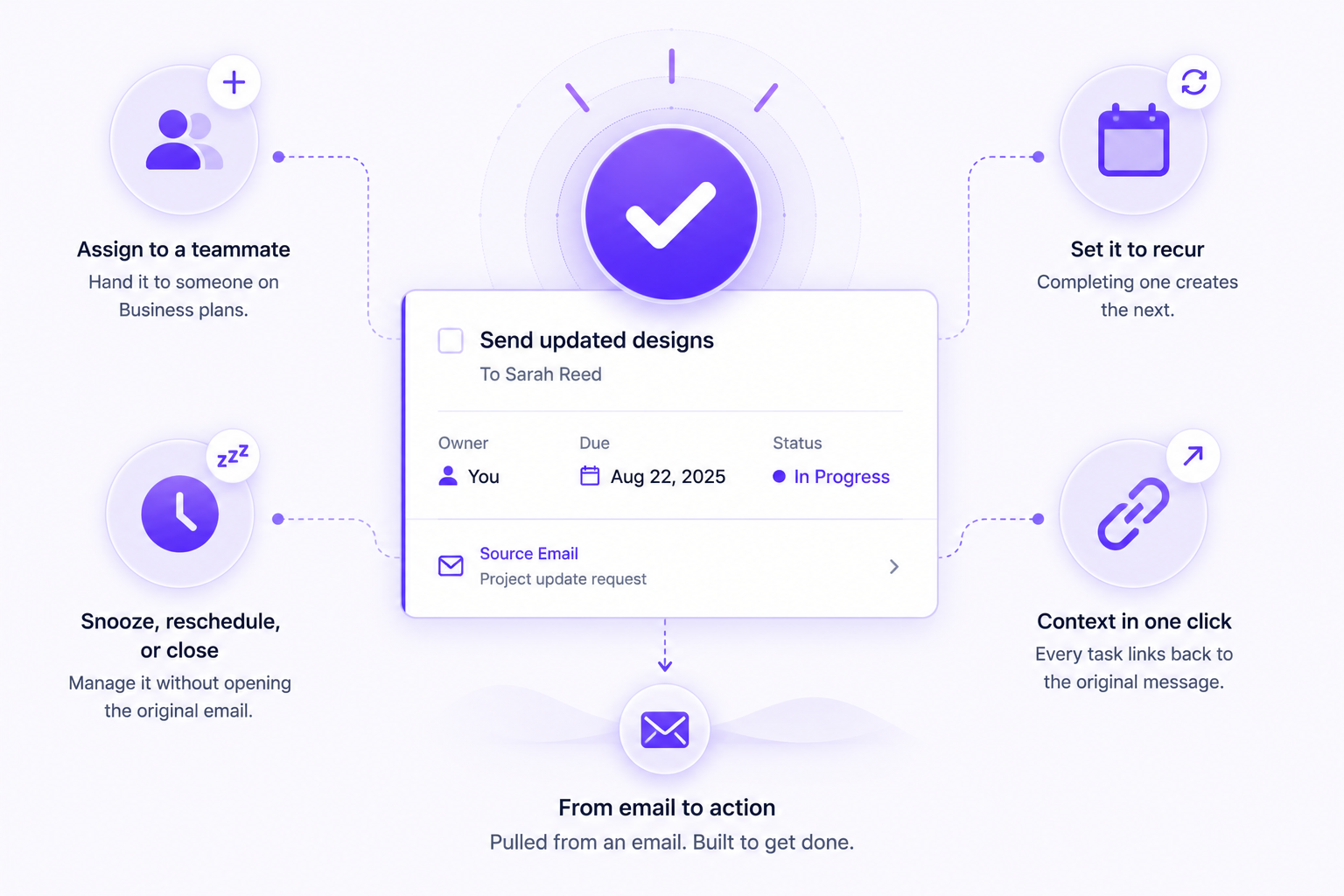
It behaves like a real task
A task pulled out of an email is not a reminder chip on a message. It has an owner, a date, a state, and a life after the thread it came from goes quiet.
- Hand it to a teammate on Business plans, rather than it only ever being yours.
- Set it to recur, and completing one occurrence creates the next instead of ending the series.
- Snooze it, reschedule it, or close it without opening the original email again.
- Every task keeps a link back to the message it came out of, so the context is one click away.
Correct it twice. CevroFlow writes the rule.
A free rule engine filters obvious noise before AI ever runs, and a condition-to-action builder handles the rest. Correct the same call twice and CevroFlow offers to turn it into a rule you can see and edit yourself, not a model quietly retraining in the background.
Rules run as plain logic right after AI finishes analyzing, at zero AI cost, and can override AI's own read for a sender or pattern you know better than it does.
What it does not do
Every tool has edges. These are ours, so you find out here rather than in week two.
It only sees what was written down. A commitment made on a call never reaches your inbox and never becomes a task.
Below seventy percent confidence nothing is created. You will see a suggestion instead, and some of those you will dismiss.
A vague hint stays vague. "Soon" produces a task with no date rather than a date it invented.
Tasks live in CevroFlow. There is no two-way sync with Asana, Linear or Todoist today.
Works with
Questions about Tasks from Email
- How does it know something is a task?
- It reads for a commitment rather than a keyword. "I will send the proposal tomorrow" becomes a task due tomorrow. A message that merely mentions a proposal does not.
- Does it track what other people owe me?
- Yes. Commitments run in both directions, so you can see what you promised and what you are still waiting on, each linked back to the message it was said in.
- What if it is not sure?
- It only creates a task on its own at seventy percent confidence or higher. Below that you get a suggestion to accept or dismiss, so the list stays trustworthy.
- What happens when I reply?
- When CevroFlow sees a reply go out it marks the promise as looking sent and leaves the final call to you.

Stop managing email. Start managing your business.
Connect Gmail and see your first prioritized day in about four minutes.
7-day free trial. No credit card. Connect Gmail in about 4 minutes.